
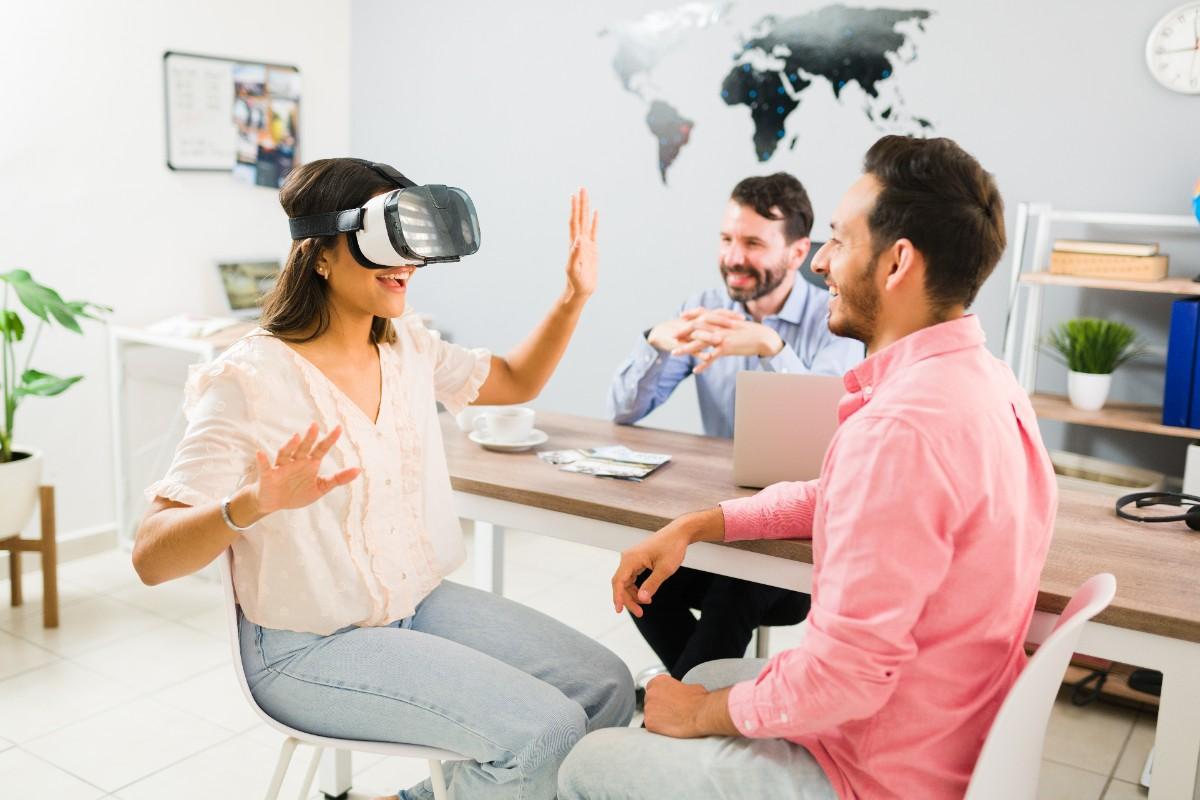
Here is a question worth sitting with. When was the last time a training programme your employees sat through genuinely changed how they behaved at work? Not temporarily. Not just for the post-training survey. Actually changed something in the way they handle a difficult client, manage a team under pressure, or respond to a high-stakes decision? If the honest answer is a long time ago or not that often, you are not alone. And the reason is almost always the same: conventional training formats ask people to remember things. Virtual reality for training employees asks them to experience things. That difference is everything.
The brain does not store experiences and instructions the same way. When done well, VR training for employees delivers something conventional formats simply cannot match. Information from a slide deck sits in one kind of memory. The memory of walking through a scenario, of making a choice, of feeling the simulated pressure of a difficult moment and responding to it, that sits somewhere much deeper. Immersive employee training is not a technology gimmick. It is a direct intervention in how memory and skill formation actually work in the human brain. And the organisations that have figured this out are pulling ahead in a way that their competitors running the same classroom programmes are starting to notice.
Benefits of Using VR in Employee Training: What the Research Actually Shows
The advantages of immersive employee training has been studied seriously for almost a decade now, and the results are consistent enough that they can no longer be dismissed as early adopter enthusiasm. PwC’s VR learning effectiveness study, one of the most comprehensive in the field, found that VR learners complete training four times faster than classroom learners. They are 275% more confident applying what they learned after the session. They are 3.75 times more emotionally connected to the content than people who received the same training through e-learning formats.
The National Training Laboratory’s research found retention rates up to 75% for immersive, participatory learning compared to 5 to 10% for traditional lectures. That gap is not subtle. It is the difference between training that modestly informs people and training that genuinely transforms how they perform. VR training for employees through immersive platforms also produces measurable improvements in confidence, not just competence, and that distinction matters because confidence is the variable that determines whether someone actually applies a skill when the moment arrives, rather than defaulting to old habits under pressure.
How VR Improves Employee Training Effectiveness
The mechanism behind why VR in Employee Training works so much better than traditional formats is not mysterious once you understand how skill formation actually happens. Skills, particularly interpersonal and leadership skills, are built through repetition in context. You learn to give difficult feedback not by reading about it but by giving it, and by experiencing the response, and by trying again with a different approach when the first one lands badly. Traditional training formats cannot provide that cycle. VR can.
In a VR simulation, every choice has a consequence that the learner experiences in real time. The virtual environment responds to how they communicate, how they move, how quickly they decide. That responsiveness is what creates the episodic memory, memory tied to a specific experience rather than an abstraction, that makes VR learning so durable. VR training for employees also eliminates the social risk that prevents genuine skill practice in real workplace contexts. People will attempt a difficult conversation with a virtual character that they would never attempt with a real colleague while everyone else in the training room is watching. That psychological safety is not a minor benefit. It is what makes practice actually transformative rather than performative.
Read More – Types of Virtual Team Building Activities that Every Organization Should Use
Use Cases of VR in Corporate Learning and Development
The use cases for Benefits of Using VR in Employee Training span more industry sectors and role types than most people initially expect. The obvious ones are there: safety training in manufacturing and construction, clinical procedure training in healthcare, compliance training in BFSI and pharmaceuticals. These are areas where the value of practising high-risk scenarios without real-world consequences is immediately obvious. A factory worker who has navigated a simulated emergency evacuation six times responds to a real one differently from someone who watched a video about what to do.
But the more interesting frontier is in leadership and interpersonal skills. This is where VR in Employee Training is producing outcomes that nothing else in the L&D toolkit has reliably matched. Leadership scenarios in VR put managers inside situations that are emotionally and cognitively demanding in ways that role-play exercises rarely achieve. A manager practising how to handle a performance conversation with an emotionally volatile team member, inside a VR environment that tracks their vocal tone, their pacing, their physical responses, is building real neural pathways for that situation. Not theoretical knowledge about it.
Still Relying on Training People Forget?
Replace passive learning with immersive VR experiences that build real skills, boost confidence, and drive lasting behaviour change.
Experience VR TrainingVR Training Programs for Leadership Development
Leadership development has a specific challenge that most L&D investments struggle to address. The skills most critical to effective leadership, handling ambiguity, building trust, communicating through conflict, are exactly the skills that are hardest to practise safely in a real organisational environment. Getting them wrong in a real situation has real consequences. Getting them wrong in a VR simulation has learning consequences instead, which is far more productive.
The data on VR training for employees for leadership specifically points to outcomes that classroom and coaching programmes alone rarely produce. Confidence in applying new leadership behaviours increases by up to 40% following VR-based leadership programmes compared to equivalent non-VR formats. Time to competence decreases significantly. And perhaps most importantly, the behavioural changes that follow VR leadership training tend to persist longer than those produced by traditional workshops, because they are grounded in experienced memory rather than conceptual knowledge.
For Indian organisations, where leadership pipelines often need to develop faster than formal training infrastructure can traditionally keep pace with, VR in Employee Training for leadership offers a scalability that is genuinely compelling. A first-time manager in Pune and a senior vice president in Hyderabad can go through the same quality of immersive leadership scenario on the same day, receiving the same depth of experience, without anyone getting on a plane. That is not a small operational advantage.
Cost vs ROI of VR Training for Organizations
Benefits of Using VR in Employee Training has a cost structure that surprises most organisations when they look at it properly. The initial investment is real. VR headsets range from approximately Rs 30,000 to Rs 1,50,000 per unit depending on specification. Content development for a custom leadership or compliance module can run from Rs 3 lakh to Rs 15 lakh depending on complexity and duration. For smaller organisations, those numbers require serious consideration.
The ROI case becomes compelling when you model the costs against what conventional training actually costs at scale. A two-day leadership development workshop for forty managers in a tier-one city, factoring in venue hire, facilitator fees, participant travel and accommodation, and two days of productivity time, can easily reach Rs 20 lakh to Rs 40 lakh for a single cohort. A VR programme that reaches the same forty managers with higher retention and measurable behaviour change outcomes, at a fraction of that cost after the initial setup, looks different in the analysis.
Deloitte’s research on enterprise VR training found that organisations achieve ROI positive on VR learning investments within twelve to eighteen months when programmes are deployed at scale. Walmart’s investment in VR in Employee Training across over one million employees produced a 70% improvement in test scores and a significant reduction in training delivery costs per employee over three years. The cost argument against VR training gets weaker the more clearly you model what conventional training actually costs, including the hidden cost of low retention and the need to retrain people who did not retain what the first programme taught them.
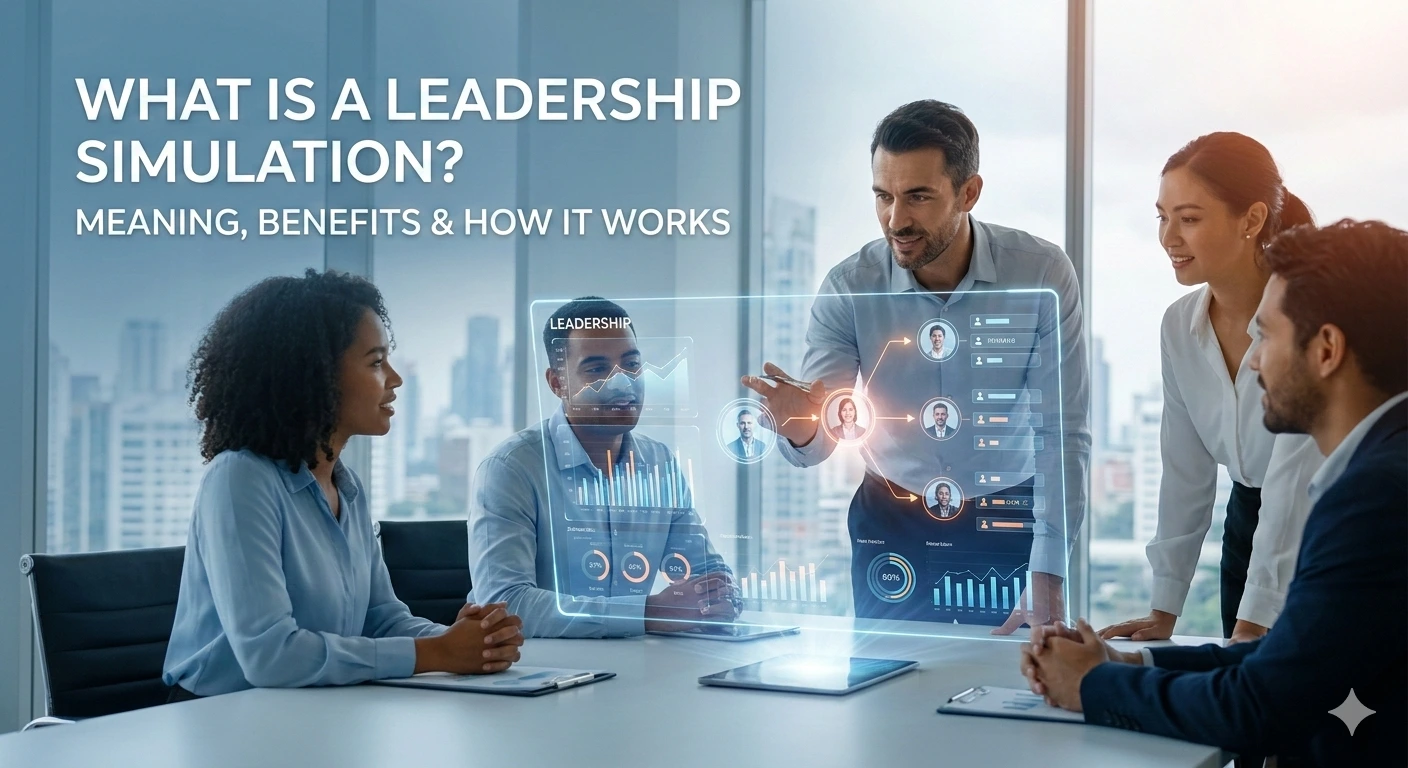
Read More – What Is a Leadership Simulation? Meaning, Benefits & How It Works
Future of Immersive Learning in Corporate Training
The trajectory of VR technology makes the future of VR training for employees genuinely exciting to think about seriously. Headsets are getting lighter, cheaper, and more ergonomically practical with each product cycle. AI integration is beginning to make simulated characters inside VR scenarios more dynamically responsive to learner behaviour, moving beyond scripted decision trees toward genuinely adaptive interactions. Biometric data capture is improving to the point where future VR platforms will not just show you what happened in a scenario but provide precise physiological data about how you responded under stress.
For organisations building L&D strategy right now, the relevant question is not whether VR will be central to corporate learning in five years. It almost certainly will be. The relevant question is where you want to be on that curve. The organisations investing in VR learning infrastructure today are building both capability and institutional knowledge about how to deploy it effectively. The ones that wait until the technology is ubiquitous will be building that knowledge from scratch in a more competitive market. The future of immersive learning in corporate training is not approaching. For the organisations paying attention, it is already here.
Virtual reality for training employees is the most significant shift in corporate learning and development since the introduction of digital learning platforms. It changes not just the medium of training but the depth of the learning experience and the durability of the outcomes. The evidence is clear, the use cases are proven, and the technology is accessible. The only remaining question is which organisations are going to move, and which are going to wait and watch while their competition builds a capability advantage that compounds with every year it has been operating.
Organisations that have already invested in VR in Employee Training report not just better learning outcomes but a measurable shift in how their people show up in the moments that matter. VR training for employees is where the evidence, the technology, and the business case now all point in the same direction. The organisations that act on that convergence today will be the ones defining what capability looks like in their sector tomorrow.