
Have you ever wondered why some managers effortlessly handle high-stakes situations while others struggle even with basic team challenges? The answer often comes down to one critical factor ,practice. Real, meaningful, consequence-free practice. That is exactly where leadership simulations come into the picture. In today’s fast-moving corporate environment, organizations across India and the world are discovering that traditional classroom training alone is no longer enough. The demand for dynamic, hands-on, experiential approaches to building great leadership capabilities has never been stronger.
In this blog, we are going to walk you through everything you need to know about what is leadership simulations, how they work, why they matter, and how simulation-based learning is transforming the way companies develop their future leaders. Whether you are an HR professional, a learning and development specialist, or a business leader yourself, this guide is going to be deeply useful for you.
What Are Leadership Simulations?
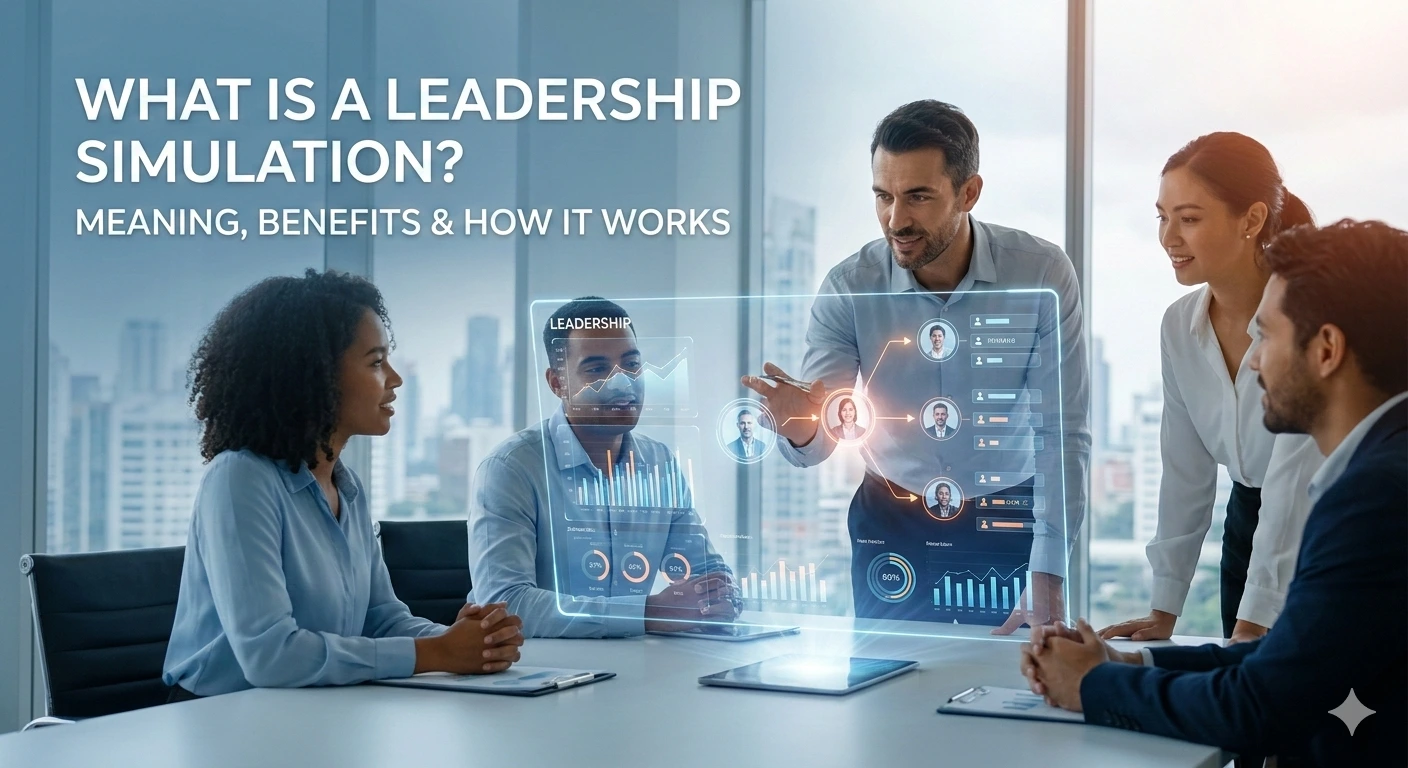
A Leadership Simulation is, at its most basic level, an immersive, scenario-based learning experience that puts people in realistic, carefully crafted situations where they have to act like leaders. In the usual sense, these simulations are not role-plays. They are carefully planned settings that reflect the real-world challenges, unpredictability, and human interactions that come with being a leader.
Think of it this way: a pilot does not learn to fly a plane by only reading about aerodynamics in a classroom. They train in a flight simulator where mistakes are safe but lessons are real. The same logic applies to leadership. A Leadership Simulation creates that flight simulator for your managers, executives, and emerging leaders.
In leadership development programs, leadership simulations place participants in complex scenarios involving team conflict, strategic decision-making, resource allocation, cultural challenges, and more – all without the real-world consequences of a wrong move. The goal is to build leadership muscle memory in a safe and structured environment.
The Growing Need for Simulation-Based Leadership Development Programs
Organizations in India are investing increasingly larger budgets into leadership development. According to several industry estimates, top Indian companies collectively spend upwards of ₹5,000 crore annually on training and development, and a growing share of that is being directed specifically toward leadership capability building. Yet, despite these massive investments, many organizations still find that their managers struggle when it comes to leading real teams through real crises.
Why the gap? Because traditional training ,lectures, case studies, workshops ,primarily builds knowledge. But leadership is not just about knowing things. It is about doing things under pressure, adapting in the moment, and making judgment calls with incomplete information. That is precisely where simulation-based leadership development programs step in and make the difference.
A well-designed leadership simulation bridges the gap between knowing and doing. It gives participants a chance to practice leadership behaviors repeatedly, get feedback, reflect, adjust, and try again ,all without any of the risks that come with trial and error in real business environments.
Read More – Top Leadership Games: Building Leaders Through Experiential Learning
How Does a Leadership Simulation Actually Work?
Understanding what is leadership simulations requires a closer look at how they actually unfold. While formats vary depending on the provider and the specific goals, most leadership simulations share a few common structural elements.
1. A Realistic Scenario Environment
Every effective Leadership Simulation begins with a richly detailed fictional or semi-fictional scenario. This could be a company facing a sudden market disruption, a team dealing with a high-conflict personnel situation, or an organization trying to execute a new strategy while managing cultural resistance. The scenario is built to feel real, because the emotional and cognitive engagement that comes from realism is what makes learning stick.
2. Decision Points and Consequences
Within the simulation, participants face multiple decision points. These are moments where they must choose how to lead ,whether to step in or step back, how to communicate with a struggling team member, how to allocate limited resources, how to handle conflict. Each decision in a Leadership Simulation leads to a consequence, and those consequences shape what happens next in the scenario. This dynamic feedback loop is one of the most powerful features of simulation-based learning.
3. Metrics: Both Financial and Human
One of the things that distinguishes a great Leadership Simulation from a basic exercise is the inclusion of balanced metrics. Good business simulation-based programs track both financial performance indicators ,revenue, cost, profitability ,and people metrics ,team engagement, psychological safety, trust levels, and culture scores. This mirrors the reality that great leadership must balance business results with people outcomes.
4. Reflection and Peer Learning
After each round of decisions, participants in a Leadership Simulation are guided through structured reflection. They examine what they did, why they did it, what worked, what did not, and how they would approach the same situation differently. Peers observe, give feedback, and share their own perspectives.
This peer learning component is one of the most underrated aspects of simulation-based learning ,it creates a kind of mirror that leaders rarely get to look into in their everyday professional lives.
Benefits of Leadership Simulation Training: Why It Works So Well
The benefits of leadership simulation training are both wide-ranging and well-documented. Let us walk through the most significant ones in a human and grounded way.
1. Safe Space to Make Mistakes
One of the most powerful things about a Leadership Simulation is that failure is safe. In real business, a wrong call in a difficult conversation or a poorly managed conflict can cost the company lakhs of rupees, damage team culture, or cause the loss of a talented employee. In a simulation, the same mistake teaches the same lesson without any of those costs. Participants can take risks, explore their instincts, and genuinely learn from what goes wrong.
2. Building Real Leadership Muscle Memory
Repeated practice inside a Leadership Simulation environment builds what experts call behavioral automaticity ,the ability to respond to complex situations with confidence and relative ease, because you have essentially been there before. Just like a seasoned cricketer does not consciously calculate ball trajectory every time they bat, an experienced leadership practitioner who has gone through multiple simulations develops an almost instinctive ability to read situations and respond effectively.
3. Developing Empathy and Emotional Intelligence
Strong leadership is never purely analytical. The most effective leaders are those who understand people ,their motivations, fears, needs, and communication styles. A great Leadership Simulation incorporates richly human scenarios that naturally develop empathy and emotional intelligence. Participants learn to navigate difficult conversations, manage diverse personalities, and lead with both heart and head.
4. Immediate, Actionable Feedback
Traditional training programs often struggle to provide participants with genuine, personalized feedback. A well-constructed Leadership Simulation solves this problem elegantly. Because every decision in the simulation leads to a visible outcome, and because peers observe interactions live, feedback is immediate, specific, and actionable. This rapid feedback loop accelerates learning in ways that classroom instruction simply cannot.
5. Aligning Leadership with Business Outcomes
The best business simulation-based programs for leadership training demonstrate, clearly and concretely, how the quality of leadership behavior directly affects business results. When participants see that their decision to avoid a tough conversation with an underperformer leads to decreased team morale and lower output scores, or that their choice to teach rather than dictate leads to higher team capability and better financial results, the learning becomes visceral and permanent.
What Makes a Great Leadership Simulation? Key Elements to Look For
Not all Leadership Simulations are created equal. If you are evaluating simulation-based leadership development programs for your organization, here are the elements that separate genuinely transformative programs from those that merely feel like expensive games.
1.Realistic Complexity and Human Dynamics
A Leadership Simulation should be like real people in all their complexity. This means that things can get messy and there are no clear answers. There can also be interpersonal tensions that are similar to what happens in real teams, and there can be ethical gray areas that need real judgment. If a simulation seems too clean or too easy, it probably isn’t getting leaders ready for the real thing.
2. Teaching, Not Just Telling
The best simulation-based learning programs for leadership embed what learning experts call the “teach, don’t tell” philosophy. Rather than telling participants what great leadership looks like and asking them to imitate it, these simulations create conditions where participants discover effective leadership behaviors through their own experience. When a leader realizes for themselves that coaching a team member through a problem produces better long-term results than simply solving it for them, that realization is far more durable than any lecture could produce.
3. The Courage to Have Difficult Conversations
One of the most consistently underdeveloped leadership skills is the ability to initiate and navigate difficult conversations with grace and effectiveness. A high-quality Leadership Simulation deliberately places participants in situations that require them to confront underperformance, deliver unwelcome feedback, address interpersonal conflict, and navigate situations where there is no easy answer. Because peers observe these interactions during the Leadership Simulation, participants receive rare and valuable insight into how they present themselves during critical moments.
4. Psychological Safety as a Leadership Skill
The best Leadership Simulations help participants understand the importance of building psychological safety within their teams. When team members feel safe to speak up, take risks, and share ideas without fear of judgment, innovation and performance both rise significantly. A well-designed business simulation will include scenarios that allow participants to practice creating and sustaining this kind of environment ,and to see, in the metrics, the direct business impact of getting it right or wrong.
Leadership Simulation as an Experiential Learning Tool
The concept of simulation-based learning as an experiential learning tool is rooted in a simple but powerful truth: human beings learn best by doing. The psychologist David Kolb famously described experiential learning as a four-stage cycle ,concrete experience,
reflective observation, abstract conceptualization, and active experimentation. A Leadership Simulation is perhaps the most efficient way to move a person through all four stages of this cycle in a compressed and structured timeframe.
When you place a manager inside a Leadership Simulation, they have a concrete experience. When they are guided to reflect on what happened and why, they move into reflective observation.
When the facilitator helps them connect what they went through to bigger ideas in leadership theory, they are conceptualizing. And when they are told to try something different in the next round, they are actively trying new things. This whole cycle, which happens many times in a single business simulation program, leads to learning that is both deep and long-lasting.
This is precisely why organizations that invest in Leadership Simulation as part of their training toolkit report significantly higher retention of learning and more observable behavioral change compared to organizations that rely solely on traditional instructional methods.
Business Case & ROI of Leadership Simulations
From a Corporate Leadership perspective, investing in Leadership Simulations is not just an idealistic people-first decision ,it is a hard-headed business decision backed by measurable return on investment.
Consider this: the cost of a poor leadership decision in a mid-to-large organization can run into crores of rupees.
A single failed organizational change effort, a poorly handled team conflict that leads to losing talented employees, or a strategic misalignment between leadership teams can cost an organization anywhere from ₹50 lakh to ₹5 crore or more, depending on how big and serious the failure is.
Compare that to the investment in a high-quality simulation-based learning program ,typically ranging from ₹5 lakh to ₹50 lakh depending on the program scope and number of participants ,and the business case becomes clear.
Great Corporate Leadership does not happen by accident. It is developed deliberately, through repeated, structured practice. Leadership Simulations are the most efficient and effective mechanism available today for doing exactly that.
Who Benefits Most From Leadership Simulations?
A common question organizations ask when exploring what is leadership simulations and whether to invest in them is: who exactly benefits from this kind of program? The answer is broader than most people expect.
1. New and Emerging Leaders
For individuals who are stepping into leadership roles for the first time, a Leadership Simulation is invaluable. The transition from individual contributor to leadership is one of the most challenging professional shifts a person can make. A simulation gives new leaders a safe space to discover their natural tendencies, build their confidence, and develop the practical skills they will need from day one.
2. Mid-Level Managers
Mid-level managers are often the most time-pressed people in an organization, and yet they are also the most critical link between strategy and execution. A well-designed Leadership Simulation that mirrors the specific challenges of the middle-management role ,managing upward while leading downward, balancing team needs with organizational demands, handling resource constraints ,can produce dramatic improvements in leadership effectiveness at this level.
3. Senior and Executive Leaders
Even the most experienced leaders benefit from Leadership Simulations, though the design of the simulation needs to match the complexity of their role. For senior leaders, simulation-based learning often focuses on enterprise-level challenges ,leading cultural transformation, building high-performing leadership teams, executing strategy in the face of uncertainty. The peer learning element is particularly valuable at this level, where leaders rarely have the opportunity to observe other leaders in action and receive candid feedback.
4. High-Potential Employees
Many organizations use Leadership Simulations as part of their high-potential identification and development programs. Running a group of high-potentials through a rich business simulation environment allows leadership to observe how these individuals think, decide, communicate, and lead under pressure ,providing far richer and more reliable data than a standard performance review or assessment center could offer.
Experience Leadership Before It Happens in Real Life
Leadership simulations give managers a safe space to practice real business decisions, handle complex team situations, and build the confidence required to lead effectively. Explore experiential leadership programs designed to strengthen decision-making, collaboration, and real-world leadership capability.
Explore Leadership SimulationsThe Role of the Business Simulation in Leadership Simulations
It is worth spending a moment on the specific role that business simulation plays within the broader Leadership Simulation framework. Not all leadership simulations are business simulations, but the most powerful ones typically incorporate significant business context because leadership in organizations is always exercised within a business context.
A business simulation element brings financial and operational realism to the leadership experience. It forces participants to consider not just the human dimension of their decisions but also the business consequences. When a leadership choice that feels good in the moment ,avoiding a difficult conversation, for example ,results in declining financial metrics on the simulation dashboard, the connection between leadership behavior and business performance becomes undeniable.
This integration of business simulation with leadership development is one of the most significant innovations in corporate learning over the past decade. It creates a complete picture of what effective leadership looks like in a real business context ,not just emotionally intelligent, but also strategically aligned and commercially aware.
Common Myths About Leadership Simulations ,Debunked
As with any growing area of practice, there are several misconceptions around what is leadership simulations that are worth addressing directly.
Myth 1: Leadership Simulations Are Just Games
This is perhaps the most common misconception. While a Leadership Simulation certainly has engaging, interactive qualities, it is fundamentally different from a game. A game is about winning. A simulation-based learning experience is about growing. The scenarios are designed with deliberate learning objectives, the debrief and reflection processes are carefully structured, and the outcomes are measured in terms of behavioral change, not scorecard rankings.
Myth 2: They Are Only for Technical or Analytical Leaders
Some people assume that Leadership Simulations ,especially those with business simulation elements ,are only appropriate for leaders with strong financial or analytical backgrounds. This is not true. The best simulation-based learning programs are designed to be accessible and engaging regardless of functional background, because great leadership is a human skill, not a technical one.
Myth 3: Simulations Replace Real Experience
No Leadership Simulation is a substitute for actual experience leading real teams through real challenges. What simulations do is dramatically accelerate the development of leadership capability so that when real challenges arise, leaders are better prepared to meet them. Think of it as the difference between a soldier who has only studied warfare in the classroom versus one who has trained extensively in realistic field exercises. Both will face real combat, but one will be significantly better prepared.
How to Choose the Right Leadership Simulation Program for Your Organization
If you are convinced of the value of Leadership Simulations and are considering implementing one, here are the key factors to evaluate as you make your choice.
First, look for a program that is anchored in a clear and evidence-based philosophy of leadership. The best simulation-based leadership development programs are not generic ,they are built around a coherent model of what effective leadership looks like and how it develops.
Second, evaluate the quality of the scenarios. Are they realistic? Are they complex enough to genuinely challenge experienced leaders? Do they incorporate human dynamics alongside business considerations? Third, consider the facilitation. A Leadership Simulation is only as good as the person guiding the debrief and reflection process. Skilled facilitation is what transforms an experience into lasting learning.
Fourth, think about measurement. Does the simulation-based learning program provide clear data on participant performance? Can you connect what you observe in the simulation to what you are trying to develop in your leadership pipeline? Fifth, look for customization. The most effective Leadership Simulations are those that are tailored to the specific culture, strategy, and challenges of your organization. A program that was designed generically may not create the specific behavioral shifts your leadership team needs.
The Future of Leadership Development Through Simulation-Based Learning
The field of simulation-based learning for developing leaders is changing quickly. Artificial intelligence, immersive technology, and data analytics are all getting better. This makes Leadership Simulations more personalized, easier to use, and easier to measure than ever before.
AI-powered simulations are beginning to enable real-time, personalized coaching within the simulation-based learning environment itself, offering each participant tailored feedback based on their specific behavioral patterns.
Virtual and hybrid formats are also making Leadership Simulations accessible to globally distributed teams in ways that were not possible just a few years ago. A leadership team spread across Mumbai, Bengaluru, Delhi, and Singapore can now participate in a shared business simulation experience together, building shared leadership language and collaborative capability despite geographical distance.
The bottom line is this: as the world changes faster, the pressure on leadership to adapt, inspire, and deliver grows stronger. The organizations that invest in building leadership capability through high-quality simulation-based learning experiences today are the ones that will have the leadership bench strength to thrive tomorrow.
Read More – Corporate Team Building Activities for Employee Engagement and Growth
Conclusion: Why Leadership Simulations Matter More Than Ever
We started this blog by asking why some leaders effortlessly handle complexity while others struggle. The answer, as we have seen, is not innate talent alone ,it is practice. Deliberate, structured, realistic practice. And that is exactly what leadership Simulations provide.
Whether you are exploring what is leadership simulations for the first time or looking to deepen your organization’s commitment to simulation-based learning, the evidence is clear: this is one of the most powerful tools available for building the kind of leadership that actually makes a difference ,in people’s lives, in team performance, and in business results.
A well-designed Leadership Simulation does not just teach leadership ,it builds leaders. It creates people who have stood in the fire, made the hard calls, learned from the consequences, and emerged with the confidence and capability to lead with authenticity and effectiveness.
If your organization is serious about building great leadership ,not just good managers, but genuinely great leaders ,then investing in high-quality simulation-based leadership development programs is not optional. It is essential.