

Most corporate training has a gap that nobody talks about openly. People sit through workshops, complete e-learning modules, pass assessments, and return to their desks having understood the content and having absolutely no idea how to apply it when things get messy and real. The reason is straightforward: understanding something is not the same as being able to do it under pressure. business simulations exist to close that gap. They put learners inside a version of reality that responds to their decisions, forces trade-offs, creates consequences, and demands the kind of integrated thinking that a slide deck or a case study discussion simply cannot replicate.
business simulations and these interactive programmes have been part of management education for decades, from early boardroom strategy exercises to the sophisticated digital platforms used across enterprises today. What has changed is the depth of what these tools can simulate, the fidelity of the environments they create, and the measurable outcomes they produce for organisations willing to use them properly. This blog walks through what business simulations actually are, why organisations invest in them, what different types look like in practice, and what role they are playing in modern L&D at a time when the quality of learning infrastructure is becoming a genuine competitive differentiator.
Types of Business Simulations Used in Corporate Training
The landscape of business simulations is broader than most people initially assume. The term covers a wide spectrum of learning tools, from short scenario-based exercises that run for an hour to multi-round digital platforms where teams compete over weeks of simulated business cycles. Understanding the different types matters because the right choice for your organisation depends on what you are trying to develop, how much time you have, and the complexity of the capability you are building.
1. Strategy and General Management Simulations
Business simulations that focus on strategy and general management put participants in the role of running a business. They make decisions across functions such as pricing, production, marketing, talent, and capital allocation, and then see how a simulated market responds. The interdependencies between decisions are what make these tools powerful. Cutting the marketing budget to improve short-term margins might hurt market share in round three. Expanding production capacity before demand is confirmed creates cash flow problems that compound through subsequent rounds. These business simulations teach systems thinking and strategic trade-off skills in a way that classroom instruction genuinely cannot.
2. Functional and Specialist Simulations
Not all business simulations operate at the whole-business level. Functional simulations focus on a specific domain such as financial modelling, supply chain management, sales strategy, or customer relationship management. These are used when an organisation wants to build depth in a specific area rather than broad strategic capability. A bank running business simulations on credit risk management, or a manufacturing company using business simulations to train procurement teams on supplier negotiation dynamics, is deploying the tool at this functional level. The specificity makes the learning more directly applicable to day-to-day decisions.
3. Leadership and Interpersonal Business Games
business games that focus on leadership and interpersonal dynamics operate differently from strategy simulations. Rather than modelling financial and operational systems, these business games simulate the human dynamics of organisations: how teams form and break down, how leaders build or erode trust, how conflicts surface and get resolved or escalated. They are used extensively in leadership development programmes, team effectiveness work, and management development curricula at both mid-level and senior level. The learning in these business games is often less about what decision you made and more about how you made it and how your team responded to your process.
4. Industry-Specific Business Simulations
The most targeted form of business simulations is industry-specific, replicating the dynamics of a particular sector with enough fidelity that participants feel they are operating inside a version of their real market. Hotel management simulations, telecom operator simulations, banking and financial services platforms, and retail management tools all exist as specialised variants. For organisations in those sectors, the accelerated learning curve that comes from running their people through business simulations built around their specific competitive environment and decision landscape is substantially higher than from generic management tools.
Experience Leadership Before It Happens in Real Life
Leadership simulations give managers a safe space to practice real business decisions, handle complex team situations, and build the confidence required to lead effectively. Explore experiential leadership programs designed to strengthen decision-making, collaboration, and real-world leadership capability.
Explore Leadership SimulationsWhy Organizations Use Business Simulations
The honest answer is that organisations use business simulations because they produce outcomes that other training formats do not. But let us get more specific than that, because the reasons vary meaningfully depending on what the organisation is trying to solve.
Learning that stays. Research from the National Training Laboratory consistently shows that participatory learning, where people actively make decisions and experience consequences, produces retention rates up to five times higher than passive instruction. business simulations are among the most participatory training formats available. The decisions you made in a simulation, the rounds where your team’s strategy backfired, the moments where you realised two hours in that your pricing had created a cash crisis, those memories stick in a way that reading a case study analysis of the same situation does not.
Safe space for genuine mistakes. In a real business context, making a strategic error at scale is expensive and potentially career-limiting. In business simulations, making that same error is a learning event. Teams get to experience the downstream consequences of poor capital allocation, of under-investing in talent, of pricing themselves out of a market, without any of those consequences touching the real organisation. That safety is not a trivial benefit. It changes how willing people are to take genuine risks, push their thinking, and test ideas they would never advocate for in a live business context.
Accelerating experience. One of the persistent challenges in developing senior leaders is that the experiences needed to build strategic and commercial judgement typically take years to accumulate through real-world exposure. business games and business simulations compress those years. Several rounds of a well-designed simulation can expose a participant to strategic challenges that might take a decade of real career experience to encounter organically. The learning is not identical to real experience, but it is close enough to significantly accelerate readiness.
Building team capability alongside individual capability. Most training interventions focus on individuals. business simulations run in team formats build something different: shared mental models, collective decision-making habits, and the kind of mutual accountability that only develops through working toward a shared outcome under pressure. Organisations that run their leadership cohorts through business simulations together often find that the shared reference point from the simulation continues to influence how that cohort works together long after the programme ends.
Example of a Business Simulation
Consider a large Indian financial services organisation developing a cohort of forty high-potential managers across its retail banking and corporate banking divisions. The L&D team decides to anchor the programme around a banking and financial services simulation. Each team of five participants is assigned to run a simulated bank competing in the same market. Over five rounds, they make decisions about deposit rates, lending portfolios, fee structures, credit risk exposure, and capital allocation. The simulation applies realistic market dynamics: if one team slashes lending rates aggressively to gain market share, competitors see that move and respond. Economic conditions shift between rounds. A regulatory change in round three forces every team to rethink their capital structure.
What happens in a well-run version of these business simulations is instructive. Teams that entered the simulation confident in their functional expertise discover in round two that their decisions are interacting with each other in ways they did not anticipate. The credit risk manager and the treasury manager, who rarely talk in real life, are suddenly in a heated conversation about whether expanding the lending book or preserving liquidity capital is the right call. The general manager in each team has to make a call without full information, under time pressure, with colleagues who have different views and legitimate expertise backing those views. That experience is not replicated by any classroom discussion about banking strategy.
This is why business games of this type have become central to high-potential development in financial services organisations in India. The simulation does not teach banking concepts that the participants did not already know. It creates the context in which they learn to apply those concepts in integrated, interdependent, high-pressure ways. Programmes built around business simulations like this typically cost between Rs 8 lakh and Rs 25 lakh depending on platform, cohort size, and facilitation scope. The ROI case, measured against the cost of replacing a senior leader who leaves due to lack of development investment, is straightforward.
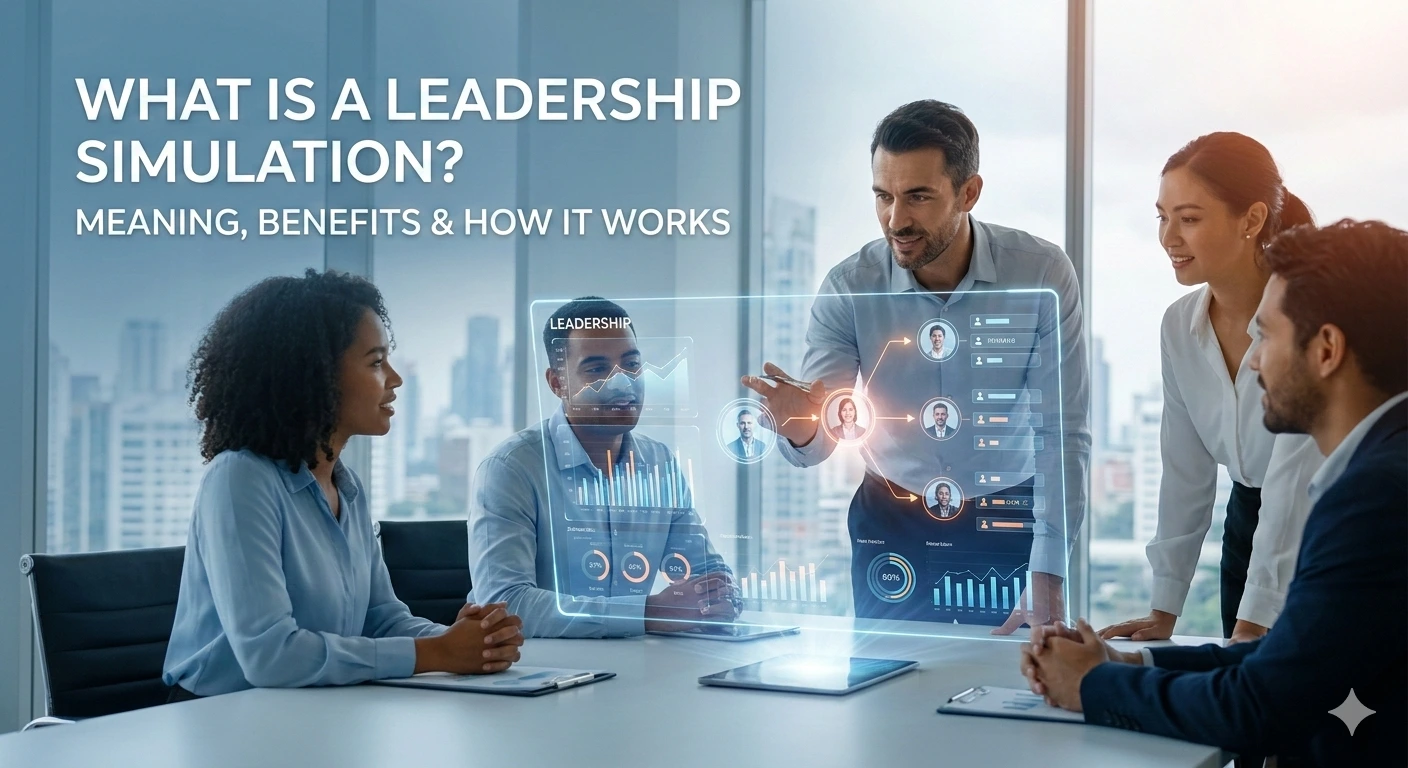
Read More – What Is a Leadership Simulation? Meaning, Benefits & How It Works
Role of Business Simulation in Modern L&D
The role of business simulations in modern L&D has shifted from supplementary to central in the organisations getting the most from their learning investments. Fifteen years ago, business simulations were typically a distinctive element in a longer classroom-based programme, the ‘fun’ day that broke up the lecture content. Today, in the most forward-looking L&D functions, business simulations are often the anchor of the programme, with everything else built around what they surface.
The reason for this shift is that the skills organisations most urgently need to develop in their people, cross-functional thinking, comfort with ambiguity, integrated decision-making, commercial acumen, the ability to lead through uncertainty, are exactly the skills that business games and business simulations develop best. These are not skills you can teach through information transfer. They have to be built through practice, repetition, and genuine experience of consequences. business simulations are the best proxy for that experience currently available at enterprise scale.
Modern business simulations platforms have also evolved to produce data that feeds directly into coaching and development conversations. Facilitators can pull decision logs, track which teams explored adaptive strategies versus rigid ones, identify individual participants who consistently deferred to others or who made unilateral calls without consulting their team. That data makes the debrief conversation after a simulation substantively different from a discussion about what happened. It becomes a forensic conversation about how people actually behave under pressure, which is where genuine development insight lives.
For Indian organisations specifically, where leadership pipelines need to develop faster than traditional mentoring and exposure approaches can support, business simulations offer a scalability and consistency of development quality that other formats cannot match. The same business simulations experience that a cohort goes through in Mumbai can run for a cohort in Hyderabad the following month with identical quality. business games that are well-designed travel well across geographies and organisational levels, making them one of the most versatile tools in the enterprise L&D toolkit right now.
The question for L&D leaders is not whether business simulations work. The evidence on that is clear and has been accumulating for decades. The real question is how to integrate them into learning architecture that is built for the actual capability challenges the organisation is facing right now, not the challenges it faced when the current programme was last designed. Organisations that get this right build something that compounds: each cohort that goes through a well-designed simulation programme adds to an institutional knowledge base about how the business’s leaders actually think and decide. That knowledge is more valuable than any certification or completion rate metric. It is the foundation of a genuine learning culture.
The best evidence for the value of well-designed business simulations is not in the literature. It is in the debrief room, when someone says out loud the thing they realised about their own decision-making that they could not have arrived at any other way. That is what good business simulations consistently produce: genuine self-insight in a context that feels relevant and real. And that is the thing that changes behaviour far more reliably than any amount of conceptual instruction. The organisations investing in quality business simulations right now are the ones building learning cultures that actually produce lasting capability change. That is a competitive advantage that compounds quietly but consistently over time.